Wednesday, 26 November 2014

Eden Brewery in Penrith and 2x Moos in Cumbria: 21st November 2014

I'd not been to the Cumbrian market town of Penrith for a couple of years (my previous trip is here), and had also been looking for an opportunity to visit the nearby Eden Brewery (not to be confused with the Eden Brewery/Eden Mill in Guardbridge, St Andrews) for a quite some time. With the very recent opening of a new craft-beer/real-ale orientated Moo Bar in Carlisle this seemed like to good time to visit the original Moo Bar in Penrith, drop in to see Eden Brewery and then have a look at this new Moo Bar 'up-the-road' in Carlisle.


Outward travel was as follows:-
  Train: Glasgow Central to Penrith (08:40 Virgin Trains - Advance to Carlisle and then Day Return Carlisle-Penrith was cheaper in this case)

Eden Brewery is located on the southern outskirts of Penrith and so when I left Penrith Station I first of all turned left past the Queen Elizabeth Grammar School buildings and then onto Wetheriggs Lane which took me south out of the town centre. I then found a narrow path through some playing fields before coming out at the A66 trans-Pennine route. This is a really busy road, connecting the M6 to the A1(M) but thankfully there are now traffic lights and a pedestrian crossing at the first roundabout from the M6. Navigating this took me into Eamont Bridge where a footbridge crosses the river alongside the old 15th Century single-lane arched bridge. There are a couple of interesting historical sites in Eamont Bridge, the first of which is known as King Arthur's Round Table.

This sadly has nothing (at all) to do with King Arthur, but is a pre-historic round earthwork somewhat destroyed by an adjacent road, however slightly further on is the seriously impressive Mayburgh Henge, a huge bowl-like henge with a high cobblestone bank and a large standing stone set in the very centre.

The bank is up to 15 feet high, is close to 400 feet in diameter and made up from 5-million+ cobblestones taken from the nearby rivers. The single stone monolith is 9 feet high (there were meant to have been another 3 of these) with the whole place having the imposing feel of a huge dawn-of-history amphitheatre - definitely well worth a visit.

I then back-tracked to the main road, this time crossed the River Lowther and went into up the hill to the Brougham Hall estate buildings. There is an access road all the way around the walls but the direct route through the (extremely) low entrance arch in the larger wooden door is far more entertaining.

Inside the large walled courtyard there are a number of small arts, crafts & leisure businesses and workshops (including Café Eden, specialising in home-made food & lovely cakes) but nestling at the far end were a number of tell-tale casks (and also a ton of malt on a pallet) indicating the location of Eden Brewery (and I think that's a pot-plant in a brewing vessel out there!).

The main brew-house is in the centre of the 3 units that Eden now occupy, with the admin and partial stores areas upstairs above the brewery floor (actually really quite high above the brewery floor).

Upstairs were head brewer & co-owner Jason Hill, with new recruit Linda Stanton (ex-UK/Commonwealth pole-vault record holder in a previous life!) in the midst of sparging a new brew in the mash-tun. Along with co-owner Steve Mitchell and delivery man/driver Tony, Eden are still pretty small, having started off operations in late 2011 with the first beers produced in the spring of 2012. Having found the large Brougham Hall premises they decided to change plans from a 1BBL plant to 5BBL and haven't really looked back since, adding a couple of 10BBL fermenters with the help of a Rural Development Programme grant in late 2013. Jason was then kind enough to take an hour out from his busy schedule and show me around the brewery setup. The rear of the original building still contains the main brewing kit - the Hot Liquor Tank, and the 5BBL mash-tun and copper.

The wort is then pumped through the heat exchanger to an adjacent room where the fermenters are located. These are mostly 5BBL vessels but the 2 new 10BBL fermenters are also located here; when these are being used it's normally a double brew-day, pitching the yeast at the end of the 2nd brew, which means a long 14 hour day for the guys. Although hop flowers are solely used in the main brewing process in some cases the beer is 'dry-hopped' by liquidised hop pellets in the fermenters, just to give an added depth of flavour and bitterness.

Cask beer is then racked off and stored in a temperature controlled out-building (along with all the cask samples), whereas bottled and kegged beer is sent off to their local sub-contractor. In some cases the beer for bottling must be over-hopped/'flavoured' since the cold-filtering does seem to strip away some of the intensity, but Jason thinks he's now got that right for most of the Eden beers.

Most bottles are delivered back for packaging and onward shipping with another adjacent unit being used to store all of these. Jason indicated that 'at some point' there will be a brewery tap in here but this is still very much in the early planning stages (outside tables here on a sunny day would make this a great place to drink some fresh, local beer).

It's an interesting (and extensive) range of beers that Eden now produce. From 'traditional' core beers such as Eden Gold (their best seller), Best, Fuggle and Emperor IPA (full of spicy English hops), Route 66 (ha!), a true bottom fermented kegged lager (really smooth with a bitter kick - hooray!), to some newish 'craft beers' full of US, New Zealand and European hops (although Jason has been using most of these hops before) that can be cask or keg and, quite recently, a number of branded beers for the wonderful Tebay Services on the M6 (easily the best Motorway Services in the country). In addition Eden have been producing their 'Withnail and I' themed beers since November 2013 (I think I must have bought one of the first gift-packs). The film was shot on location in Cumbria, in part just up the River Lowther from Eden Brewery, and with this being one of Jason's and Steve's favourite films, they thought - why not ? (The beer names associated with the film and the film quotes work well too - 'I demand some booze' etc...). Currently 7 beers are in the range (with another 'interestingly named' beer coming next year) comprising such diverse beers as those below (Antifreeze is included in the now infamous Best of British Beer Christmas Tree Advent Calender)...

...as well as Black Jake (a fantastic Seville Orange porter tasting of dark chocolate jaffa cakes), Scrubbers (a very light coloured US pale ale) and Terrible C (with a spicy green chilli kick at the end). Jason has definitely made some interesting and very tasty beers here, and knows what he wants - sessionable beers, but that doesn't have to means 4 pints in a row, just 2 or 3 bottles to savour at a time is fine, as something new will always be picked up. Many thanks to Jason for the look around and the great chat and I departed with a couple of Eden beers (and had brought down an Alechemy one for Jason), leaving Brougham Hall through the wooden door (again) before walking through the remainder of the Brougham estate to the moor road out of Penrith. Just where the rivers Eamont and Lowther meet are the ruins of Brougham Castle, standing guard over the rivers and (when open) there must be great views down the river valleys from the top of the still accessible castle keep.

I then turned back towards Penrith, found an underpass under the busy A66, and walked up a fairly steep incline into the Carleton Village area of Penrith. At the top of the hill is The Cross Keys, located where a number of paths from England and Scotland used to meet.

I headed into the main bar at the front left of the building and found a light wooden central bar supported by masses of bricks, with the interior full of exposed stone walls, low ceilings and some fantastic gnarled wooden support columns.

There were 2 beers on hand-pull that I could see, one from nearby Tirril Brewery and Merlin's Oak from Brains (a malty & sweet honey beer that I'm quite partial to), so I ordered a pint of the latter and some food, and sat down at one of the tables dotted around the windows of the bar. There is a cracking, slightly sunken games room adjacent to the bar (with a pool table and darts board) and the owner was quite happy to show me the large restaurant upstairs - this is almost medieval banqueting room in build and scope with a huge wooden canopy, flickering candle lights, an outside balcony and large windows giving a fantastic view over the river valleys & hills (but I couldn't really take a photo - damn!). I was shepherded back to the bar where my food was almost ready - a nice tuna-mayo sandwich & salad with some chips (hey, it was cold out there and these were piping hot).

Happily fed I headed out of The Cross Keys as the place was starting to fill up with Friday lunchers and walked further up Carleton Road and then towards the town centre of Penrith. Just before the actual market square is the tastefully understated frontage of Moo Bar, which used to (in the 19th Century) house & shelter various types of cattle bound for the nearby market (and hence the name).

The front bar is fairly small and basic, with a couple of wooden tables opposite the bar, bench table seats on the other side and some seats at the bar. But the beer choice at the polished mahogany bar was excellent - 6 hand-pulls (mostly from Cumbrian breweries, though it was great to Cromarty's lovely Red Rocker there as well) & 4 interesting kegged beers/ciders and there were lots & lots of bottled (and canned) craft beer in the fridges. I went for 3x 1/3rds of AAA by Fell Brewery, Esthwaite Bitter by Cumbrian Legendary and Obsidian by The Hop Studio, the latter a seriously good roasty, bitter (and thin) Black IPA, just what it should be.

They do live music downstairs at weekends and there's a lot more space & seating upstairs with a plenty of comfy seats, the odd beer barrel table and a wide screen TV showing mostly sport on one of the walls (I think upstairs has been nick-named the Udder Room - ouch!).

The Moo Bar was conceived and is owned by Nigel Tarn, who already part-owned a couple of eating/drinking establishments in Penrith and who had sold a drinks business (Turbo Drinks) for a more than decent sum in 2012 (he's also a beer writer with a couple of books published, nice to see). After opening in early 2013, Moo Bar Penrith seemed to be working out very well and Nigel applied to have a premises in Carlisle developed into a similar concept, and with this now open I headed back to Penrith train station to catch the next train to Carlisle (only 15 minutes away). Normally if I had to stop or change trains in Carlisle there was only the choice of a couple of Wetherspoons down Botchergate, but with the new Moo Bar Carlisle open on Devonshire Street, only 5 minutes from the station, it really is an easy decision to head there instead. Moo Bar Carlisle has a similar understated, but perhaps more elegant frontage in comparison to the Penrith premises...

...but inside things are on a completely different scale. The sweeping, wooden canopied bar is the most obvious difference - it seems chock-a-block with evenly spaced hand-pulls, all 24 of them, with no space left on either side. There's no doubt that you are initially completely bamboozled by this amount of choice, so the best thing to do is either start from one side or ask the friendly bar-staff for some recommendations; I did both.
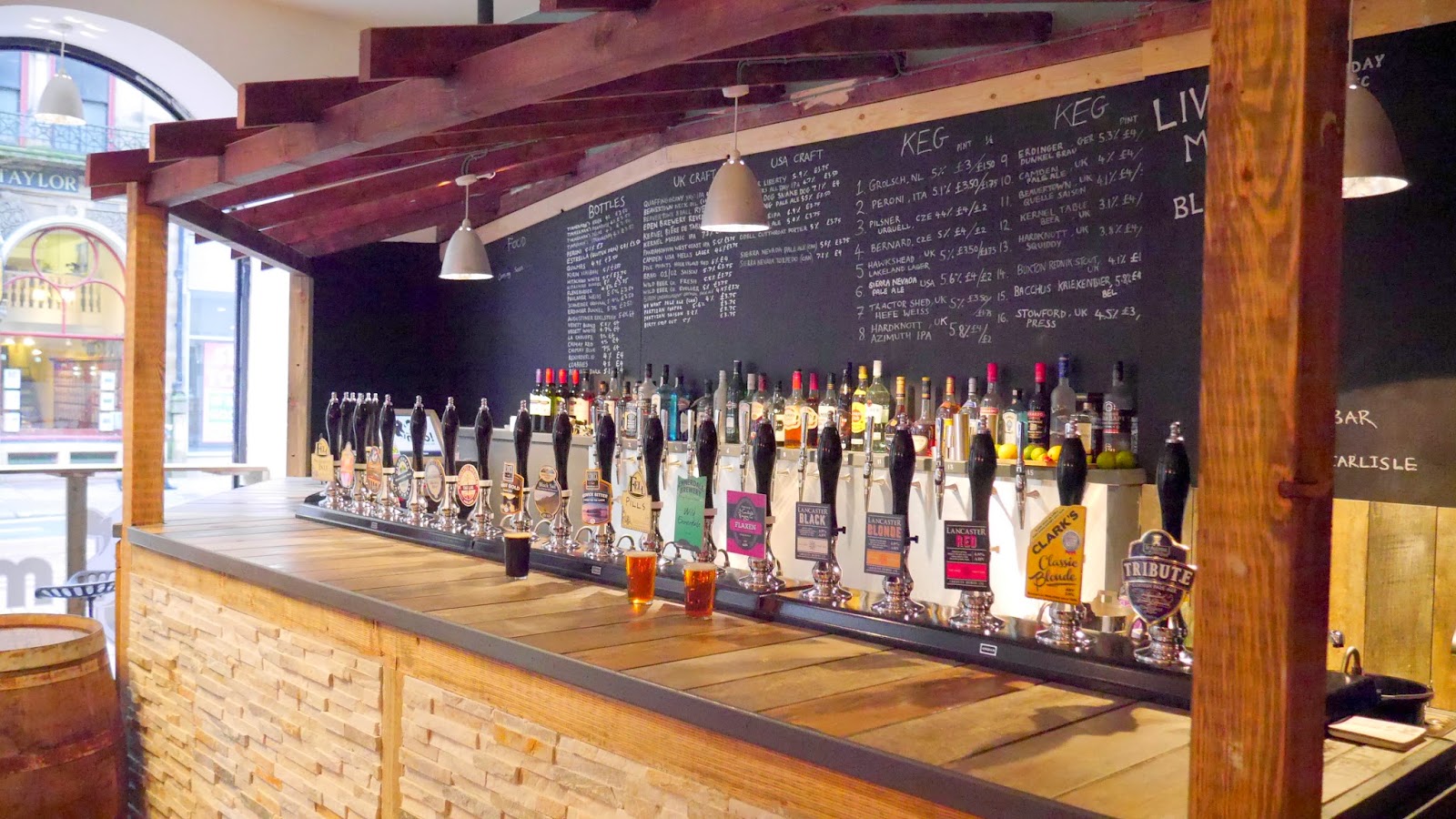
As in Penrith, the majority of the beers are Cumbrian (I knew some of them - Hardknott, Hawkshead, Stringers etc..., but not that many) and there have also been cask beers from Siren, XT, Arbor and others. And that list doesn't include the 16 shiny keg fonts at the back of the bar with Camden, Beavertown, Buxton, Tractor Shed, Bernard etc... beers available, and then add an even more extensive bottled & canned beer choice than in Penrith; there really is an impressive selection here, especially at £3.00/pint (cask) and £3.50-4.00/pint (keg). I took a number of 1/3rds (again) and sat down with a beery acquaintance for a chat and a look around the fairly large downstairs space. There are a lot of larger wooden tables & benches, this afternoon mostly occupied by a good range of people (young and old) trying out the beers (and it supposedly got really busy by the 5-o'clock (beer o'clock) Friday klaxon) and as with the Penrith bar there are some interesting features including a high throne-like wooden chair...

...and some sofa-seats, a huge mirror and cow-hide pouf cushion/seats at the back of the room.

I also liked the glass window in the floor through which you could see the casks being changed...

...but thankfully this wasn't quite as high as the Blackpool Tower glass floor I'd been to a couple of weeks previously.

It was almost all Cumbrian beers that I sampled in Carlisle and interestingly enough the revamped Carlisle Brewery Flaxen golden ale was the best brew I tried that afternoon, it certainly had a depth of orangey-lemon bitterness that had been slightly missing from some of their first-off brews last year. One thing that is missing from both of the Moo Bars is food, but the Carlisle Moo Bar also encompasses the upstairs floor, and plan to provide food to complement the beers; meat & cheese platters and other nibbles would definitely go down a storm here (and probably get you asking for another beer). Hopefully that should happen in the New Year and I'll certainly be back to give it a go. Carlisle as a beer destination ? Who would have thought it !

Return travel:-
  Train: Carlisle to Glasgow Central (16:02 Virgin Trains + many others)

Thursday, 6 November 2014

Stirling to the Alloa Octoberfest: 1st November 2014

The end of October normally means a trip out to Alloa for the Alloa Octoberfest and this year was no exception (I'm way too predictable/boring at times). I've been doing this for a few years now and I've still not run out of surrounding places to visit - this time I was going to criss-cross the River Forth a number of times and walk from Stirling to Alloa via the small town of Cambus.


Outward transport was as follows:-
  Train: Glasgow Queen St. to Stirling (18, 41 on the hour - fast trains cancelled this w/end)

On leaving Stirling train station I headed across the steel & glass pedestrian bridge over the mass of railway tracks and on towards the Forthside area of Stirling. There's a old footbridge here over the Forth to Cambuskenneth and (as almost everywhere in Stirling) you can get a great view of the Stirling Castle (here from the far side of the bridge).

Just across the bridge are the ruins of the 12th Century Cambuskenneth Abbey - only the high bell tower remains, probably having being used as a lookout tower over the Forth river plain.

I then walked past the Abbey Inn up towards the main road out of Stirling towards the Ochil Hills. There are some great views of the Wallace Monument here, showing how it's set atop a long sloping volcanic escarpment.

I crossed the railway line onto the main road and then headed almost due east out of Stirling. This led to a quieter cycle route (Sustrans 76) which brought me more than half way out to Cambus. The Sustrans route headed straight on but I'd had a look at the map and it seemed as if there was a path through/around the sign-posted industrial estate. This took me back over the train line and then alongside the huge acreage of Diageo bonded warehouses. The smell of whisky was certainly prevalent in the air and it's not surprising that they even have their own fire vehicles just-in-case of an emergency.

I eventually found the path at the end of the industrial estate and followed the narrow (and muddy) track as it skirted more of Diageo's buildings until reaching the Forth shoreline. It's here that the River Devon empties into the Forth with a noisy weir changing the level of the Devon just before the 2 rivers meet.

At the footbridge over the River Devon is the new Diageo Cambus Cooperage, which is meant to blend traditional skills & experience with state-of-the-art productions skills (including robotics) to provide up to 250,000 casks year - there was certainly quite a number stacked up outside today.

It was here that I connected again into the official Sustrans 76 route and this took me the short distance into the small village of Cambus. On the main road I found the brightly coloured front of The Tearoom at Cambus (I think this was formerly the Cambus Inn).

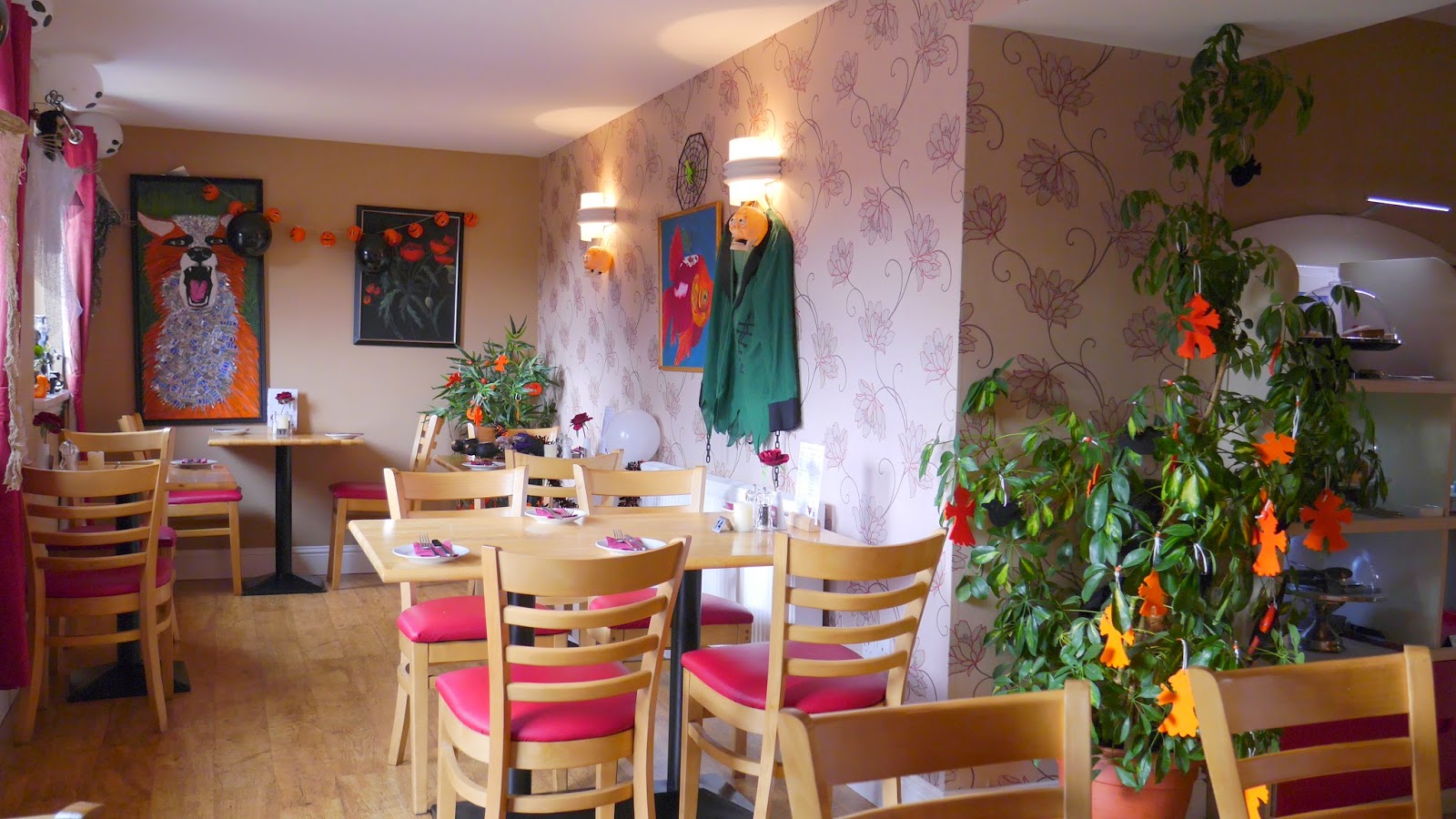
I went in the central door and found myself almost immediately in front of the light-coloured wooden bar area set away in the corner of the main room, which along with all the light wooden floors and associated chairs & tables certainly gave the place a bright & spacious feel. Also set all around the room were masses of colourful Halloween decorations - bats, pumpkins, ghouls, ghosts, black & white balloons - it really is incredible how popular Halloween is nowadays.

There was a bit of a racket coming from one of the larger parties of adults & kids in the front room so I asked the young staff if I could be shunted off into one of the side rooms and it wasn't a problem - it was a lot more peaceful at the back of the building near the entrance to the rear beer garden. In amongst the decorations they have quite a lot of interesting pictures on the walls - I liked the 'Irn Bru' cat and the multi-coloured goldfish frieze, and there were also quite a few smaller pictures for sale, mostly wildlife originals featuring cows, robins etc...

Unfortunately the beer choice at the Tearoom was not that exciting - on draught Belhaven Best, Guinness or Tennents (I went for this, I was thirsty after my ~6 mile walk), with Miller or Corona in bottles, which is a shame since they're only a few miles from some great Scottish breweries, namely Williams Brothers and Harviestoun. They do snacks from 10am and main meals from 12noon, but I was quite happy just to get a tuna mayo baguette with cheese, and when it came *that* was definitely how you do a baguette properly. Cut it in half, add masses of tuna mayo, cover with cheese on both halves of the baguette (not just one side/or the middle), and then toast it so there are some nice crispy burnt bits.

The tearoom is an excellent place for a stop on the way from Stirling to Alloa (or even further afield to Kincardine and Fife), I just wish they would do some more interesting/tasty beer (I guess that's what tripadvisor reviews are for). I headed out from the tearoom and continued east towards Alloa and could have just gone straight on into the centre of town but decided to take a slight diversion to the bank of the Forth. There's a tarmac'd path part of the way and then a right-of-way track along a disused railway line (yet another one - I could be catching a slight case of 'trainspotting'). I followed this across a couple of gates, past lots of curious sheep and up an incline to where the old Alloa Bridge across the Forth used to be. It was dismantled back in 1971 but the pillars & supports are still present showing how it curved slightly over to the south (Thorsk) side of the Forth.

I then back-tracked to the path, went down to a farm and climbed over another couple of gates before coming to the Kelliebank area of Alloa. The Williams Brothers brewery at Forthbank is here, but since there were a number of security guards milling about I didn't wander into the industrial estate but continued on into Alloa itself. Here my curiosity did take me into the Thistle Bar just off the High Street...

...although there was only Caledonian Flying Scotsman available on one of the 2 hand-pulls, and I also passed the newly opened JD Wetherspoon pub (The Bobbing John) on Drysdale Street...

... before coming to Alloa Town Hall, the site of the Alloa OctoberFest (extending to November 1st this year).

It's a nice small festival in a compact enclosed venue which doesn't change too much year-on year-out and is never that busy (at least on Saturday afternoons), and it was great to meet up with some regular festival goers, real-ale Ronnie (enjoying retirement from The 3 Judges) and some talented brewers (Stuart from the Kinneil Brew Hoose & Dave from DemonBrew). There's normally an excellent selection of Scottish beers and some from further afield, but this year I'd somehow tried all of the English beers that were available before (Oakham and Saltaire). Instead I had pinned my hopes on the solitary Welsh brewery present, The Waen Brewery from deepest, darkest central Wales, and I certainly wasn't disappointed. They had 3 beers on hand-pull, Pamplemousse (a nice orangey pale ale), Landmark (a stronger resiny bitter) and their Chilli Plum Porter (full of dark chocolate, red fruits and a definite spicy chilli kick in the finish) - all were good but the Chilli Plum Porter was superb, a brilliantly balanced chilli beer - nice one brewster Sue from Waen!

The trains from Alloa aren't brilliant on Saturday afternoon and I had to rush off without trying a number of interesting Scottish beers - drats! However this allowed me to get off the train at Stirling and head to a relatively new pub/bar just past Stirling's main pedestrianised shopping street, the Curly Coo Bar, only 5 minutes or so fast walk from the train station.

There used to be a Curly Coo Bar in Crieff but the owner/landlady Mandy had decided to relocate to Stirling in December 2013 (there's simply a lot more tourists (and locals) in Stirling than Crieff). It's styled as a Whisky Bar (with more than 120 of them in stock & on display) but there are also keg fonts for Williams Brothers Joker IPA and Harviestoun Schiehallion and Bitter & Twisted and there's just been a single hand-pull installed with a cask of Orkney Dark Island going on on Friday afternoons. Add a fridge stocked with great bottled beer (including that from local Fallen Brewery, high seats at the bar, comfy bench seats & tables around the walls, some large wooden barrels and it's well worth a visit.

Owner Mandy normally sits in the middle of the dark wood panelled bar at the back of the single large room and chats away with everyone who comes in - she has a bit of a fearsome reputation but really she is more than polite and welcoming to absolutely everyone. I only had time for a bottle of Fallen Odyssey (lovely & g/fruity bitter), but from what I saw of the place it's by far the best pub in Stirling - beer wise and just in general as a welcoming and interesting pub.

Return transport:-
  Train: Alloa to Stirling (45 on the hour)
  Train: Stirling to Glasgow Queen St. (23, 44, 53 on the hour)

Thursday, 23 October 2014

Into Darkness from Abernethy to Glenfarg: 18th October 2014

Having been to various beer festivals & breweries in the past few weeks I was keen to get out in the fresh air and get back to walking between some interesting pubs. One of my favourite places in the autumn is the stunning Perthshire countryside, and out in Abernethy in southern Perthshire there is a really great pub that I'd not visited in some time, the Cree's Inn. Looking at this on the map I also spotted an intriguing disused/dismantled railway line (and associated tunnels) which I could hopefully take to walk through the Ochil glens to an old coaching inn, the Bein Inn, before heading back home.


Outward transport was as follows:-
  Train: Glasgow Queen St. to Perth (41 on the hour + others)
  Bus: Perth Bus Station to Abernethy (Stagecoach 36; 20 on the hour)

The centre of Abernethy is now bypassed by the main road and so when I got off the bus I had to head up a narrow street towards the church, the small Museum of Abernethy and the war memorial on the main street. There's no doubt what feature dominates the small town - the high Round Tower of Abernethy built at the end of the 11th Century as the bell tower for the adjacent church. It's 1 of only 2 Irish-style round towers left standing in Scotland (the other is in Brechin).

There's also a Pictish symbol-stone at the base of the tower which was discovered nearby; it doesn't date with the Tower (it's from a lot earlier) but from an upkeep point-of-view it makes sense to keep them both together.

The key for the tower is kept at the Berryfields Tearoom opposite the tower and so is only available when the tearoom is also open. Thankfully today was one of those days & times and so I went inside to pick it up. It's a huge wrought iron thing with a colourful tied ribbon on it, deliberately done, I guess, to make it difficult to lose or forget. The lock for the large wooden door is quite easy to turn and once the door is opened there are a couple of information panels at the base of the tower on its history and that of Abernethy.

Unsurprisingly there are quite a few winding steps which lead up the top of the 22-metre high tower but it's no real problem climbing them. A bit trickier is the ladder at the top which leads to the main hatch - the latch for this was fairly tight and the hatch sprung up quite fast.

When I got the top the views were definitely worth it - great 360-degree panoramas of the close-up Ochil Hills to the south, the Strathearn river plain to the west, and north-east to the River Tay, the Carse of Gowrie and the Sidlaw Hills (Dundee may have been out there somewhere but I couldn't see it today).

I could also see my next destination, the Cree's Inn, nestling amongst all of the multi-coloured foliage at the edge of Abernethy.

I spent a bit of time at the top of the tower and by the time I headed back down the lights had automatically timed out, but there are light switches all the way down the staircase. I gave the key back to the staff at the tearoom and then headed into the main street of Abernethy, but to be honest, there's not a lot there - one small 'corner' shop, a hairdressers and a pub (The Inn, Abernethy, which seemed quite nice). I had hoped to buy some Abernethy biscuits in Abernethy but the nearest local bakers seemed to be in Bridge of Earn or Newburgh - drats! If I had had more time I might also have tried some of the walks around Abernethy Glen to the south of the town, but instead I headed to the east of the main street where the Cree's Inn is located. It's a really pretty pub (look at all that ivy), is named after the first owner Thomas Cree and it opened up dead on 12noon.

I think the last time I'd been in was about 5 years ago, on one snowy afternoon on the way to Dundee, but it doesn't seem to have changed much in the intervening years. I mentioned this to the young barmaid and she said the only thing that she knew which had definitely changed was that the carpet in front of the bar had been replaced with a hard wood floor - probably to the relief of everyone who had to clean-up in the pub. The main black-wood bar counter is immediately on the left hand side of the long bar/lounge area and they normally have 6 hand-pulls on from various English and Scottish breweries (I'm amazed that they can get through that many). Today the choice was a bit safe, but I was happy enough to take a pint of Gales/Fuller's Seafarer, a decent amber bitter (also available were Thwaites Wainright, Greene King IPA, Taylors Golden Best, Loch Ness WilderNess & St Austell Tribute).

They normally do decent pub meals (and takeaway food) at lunchtime but the barmaid explained that there hadn't been any food that week because the owner's wife had gone down with the autumn cold/flu thing that seems to have infected 1/2 of Scotland - another drats! Instead I had to make do with a packet of spicy peanuts and asked permission to take a couple of photographs of the bar. The main room extends for quite a distance through a couple of partitions to the brick fireplace at the back with masses of dried hanging hops & pump-clips adorning the wooden beams, and prints of 'ancient' beer adverts (loads of Tennents ones), collections of beer mats and pictures of old Abernethy dotted around the walls - the place is definitely a bit of a labour of love to the hop and the hop-based drink.

There's a smaller seated snug-area across from the bar where there are more dried hanging hops, a dart board and some character cartoons (including one of the owner).

I was really tempted to stay and try a few more beers but decided that at least some substantial food was a good idea. I therefore headed back to the Berryfields Tearoom (for the 3rd time that day, I was thinking of getting one of their loyalty cards).

The choice (and especially the service) really is very good in here, from breakfasts to soups to paninis, but since I wanted something fairly quickly I went for a bacon roll and pot of tea, the latter served in a really dainty china cup with equally dainty milk-jug.

Various people did come in-and-out of the tearoom for takeaway goodies (the scones did look fantastic) but I decided to start off on my search for the disused railway line. This involved a walk back along the A913 to Aberargie where I crossed the road and took the first minor road on the left, followed by another left on next narrow lane (there was a small "Private Road, please do not believe your Sat-Nav" notice here which I 'missed'). I went past a small farm and a couple of empty buildings and then up an incline until I came to a high stone viaduct which looked like an extremely promising candidate for the disused railway line. I thought I might have to scramble up the bank of the viaduct, but there was easy access to the railway line path on the far side.

The railway line used to be part of the direct line from the Forth Railway Bridge to Perth but was closed in 1970 when a lot of the railway bed route was needed for the M90 motorway. The path is quite clear of debris and easy to follow but it wasn't long before I came to a dense copse of trees which almost completely hid the 1st tunnel entrance. This tunnel is (doh!) pretty big and since it curves considerably was completely dark inside with absolutely no sign of the tunnel exit from the entrance. *DEFINITELY* take a torch of some sort (I took a large LED lantern) when exploring through this.

The tunnel is about 500metres in length, has lots of bricked up side refuges in the tunnel walls, but was very dry and almost completely empty. Most of the way through the tunnel it was so dark that I couldn't really get any decent photos until the exit came into view, which (I have to admit) I was quite glad to see. The path of the railway track then continued arrow-straight through lots of fairly dense undergrowth and got quite muddy in places.

Slightly further on I came to a branch in the path - right went up to to farm track, the old railway line continued left and in-and-out of a dip until I eventually came to the entrance for the next tunnel - this was a lot muddier and overgrown than the last one.

This 2nd tunnel is lot straighter than the 1st and about the same length, but even though there was always a slight dim light present all the way through the tunnel there were still a couple of times when some large masses of piled logs appeared out of the darkness without any warning! And at the exit of the tunnel there seemed to be the remains of a burnt-out car.

The tunnel comes out immediately before another impressive stone viaduct, this time crossing the River Farg and the B996 road. To get down to the roadside I had to cross the viaduct and then scramble somewhat down the left side, although it's a fairly well defined path.

After that it was a matter of walking for about half a mile or so on the verge of the road (it wasn't that busy, only 2 or 3 cars went past giving me a wide berth) until I reached the Bein Inn, located at the junction of the A912 road (and with great views of the Ochil Hills).

I checked the bus times and then went into the main reception of the Inn and then straight through into the MacGregor Bar. Even mid-afternoon it was fairly busy with families & couples out for a late lunch with the single member of staff coping pretty well. On the small bar at the far end of the room was one hand-pull with Inveralmond's lovely citrusy Ossian available (although there were a number of bottled beers available both in the fridge and at room temperature).

I took a pint of Ossian, got out of the way of the people eating and headed back into reception area where there were a number of small tables and some comfy sofa seats in front of the fireplace. It was a nice relaxing place to sit for a beer and there were papers about and also WiFi access available (there was absolutely no 3G/4G signal at all).

Pint finished I headed out for my bus. I could have returned directly to Perth but since I had a bit of time to spare (unusual) I was able to take the bus in the opposite direction to the small village of Glenfarg a couple of miles further down the B996 (there was no way I would have risked walking along even this fairly quiet B-road for that distance). I got off at the corner of Glenfarg main street where the magnificent, almost castle-like structure of The Glenfarg dominates the street.

I entered through the front foyer and looked in at number of rooms off the main corridor for the bar (most were, again, fairly full of people having something to eat) before the owner eventually spotted me, explained that the bar was only open in the evening, but was happy to direct me to a small side-room (and associated side-bar) at the front where there were a couple of comfy seats. From there I could just about spot the pump-clips for the beers that were on in the main bar, Wells' Bombardier and Waggle Dance, so I ordered a pint of the Waggle Dance (very sweet honey up-front masking perhaps some light citrus bitterness, but it certainly got my energy levels back up).

From what little I saw of The Glenfarg it seemed a classy place and the staff were very polite & welcoming. Before my bus back I had a little bit of time to wander around some other parts of Glenfarg (the noise from the nearby M90 Motorway is always present around the village) where I found the small village store (with lots of bottles of Shepherd Neame Bishops Finger available for some reason) and also this building which intrigued me, the old village library (now a private house complete with clock tower, wow!). All told it was certainly quite an interesting day out in this part of southern Perthshire.

Return transport:-
  Bus: Glenfarg to Perth Bus Station (Stagecoach 56; 12 on the hour)
  Train: Perth to Glasgow Queen St (13 on the hour + others)